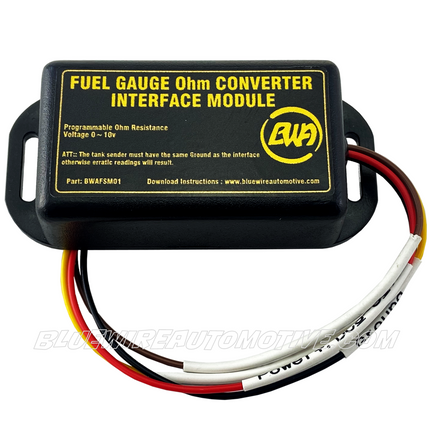
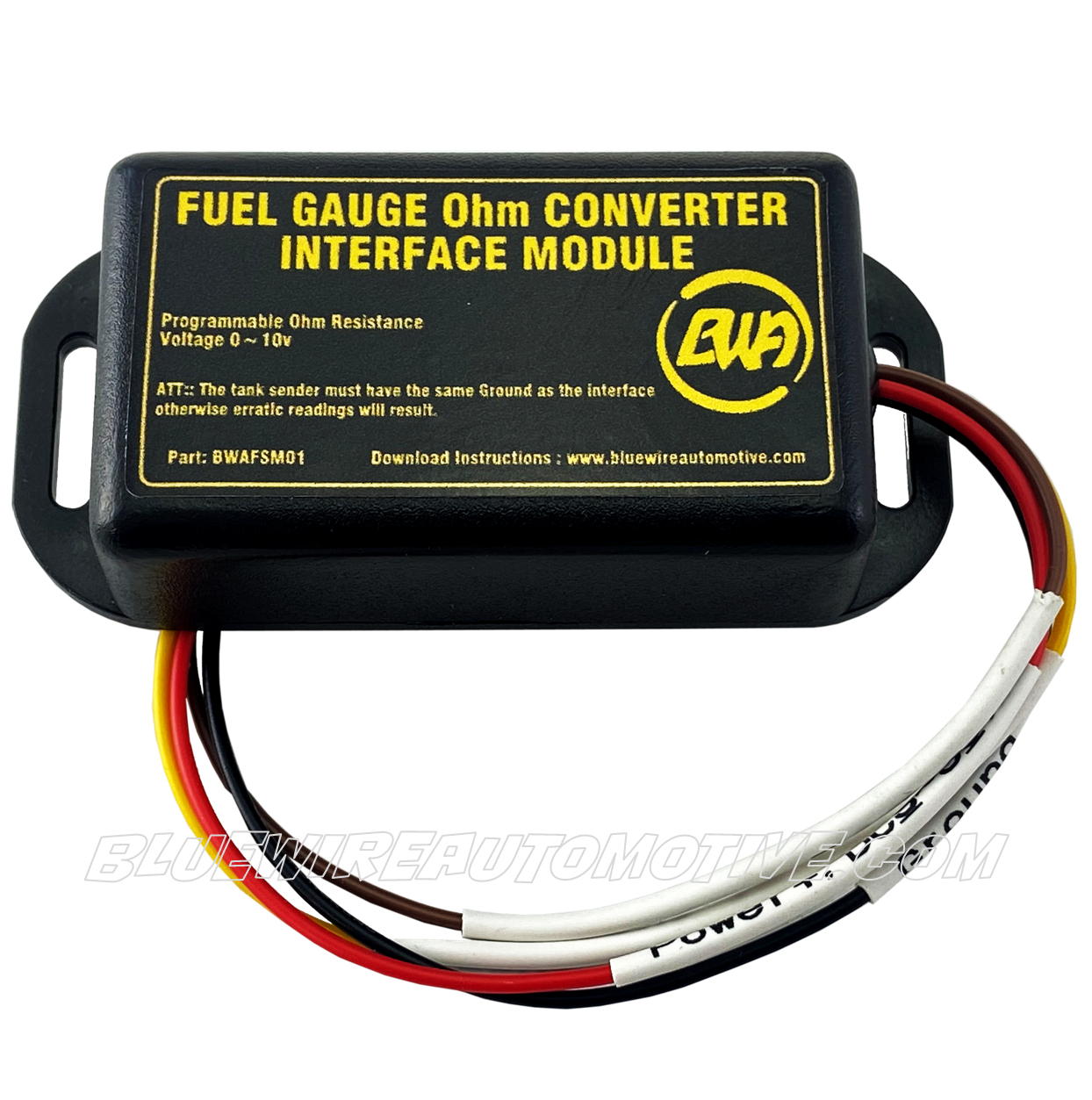
Make almost any fuel sender work with almost any fuel gauge with our Universal Fuel Sender Interface Module.
Fuel gauges are designed to operate within a specific resistance (Ohm) range, but different vehicle and gauge manufacturers use different ranges. This can create compatibility problems when installing aftermarket gauges, replacing a fuel tank, upgrading a fuel sender, or combining original and aftermarket components.
The BWAFSM01 Fuel Sender Interface Module is designed to solve this problem by acting as an interface between your fuel sender and fuel gauge, allowing senders and gauges with different resistance ranges to operate together.
Match Your Fuel Sender to Your Gauge
The module can work with resistive fuel senders and gauges using resistance ranges from 0 to 5000 Ohms, including many common configurations such as:
10–180Ω • 0–30Ω • 0–90Ω • 240–33Ω • 73–10Ω and more
This means you can retain your original fuel sender with a new aftermarket gauge, or use a replacement sender with your existing fuel gauge.
Key Features
Universal Fuel Sender to Gauge Interface
Reads resistive fuel senders from 0–5000Ω
Works with a wide range of fuel gauges
Corrects mismatched sender and gauge Ohm ranges
Helps reduce erratic gauge movement caused by fuel slosh
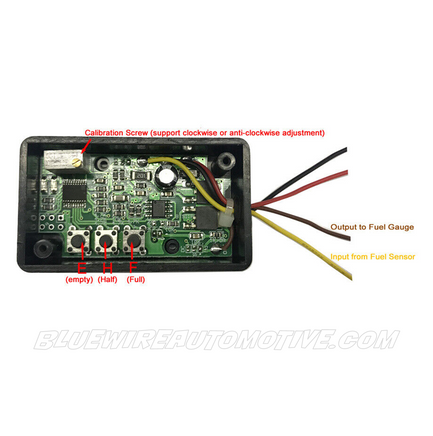
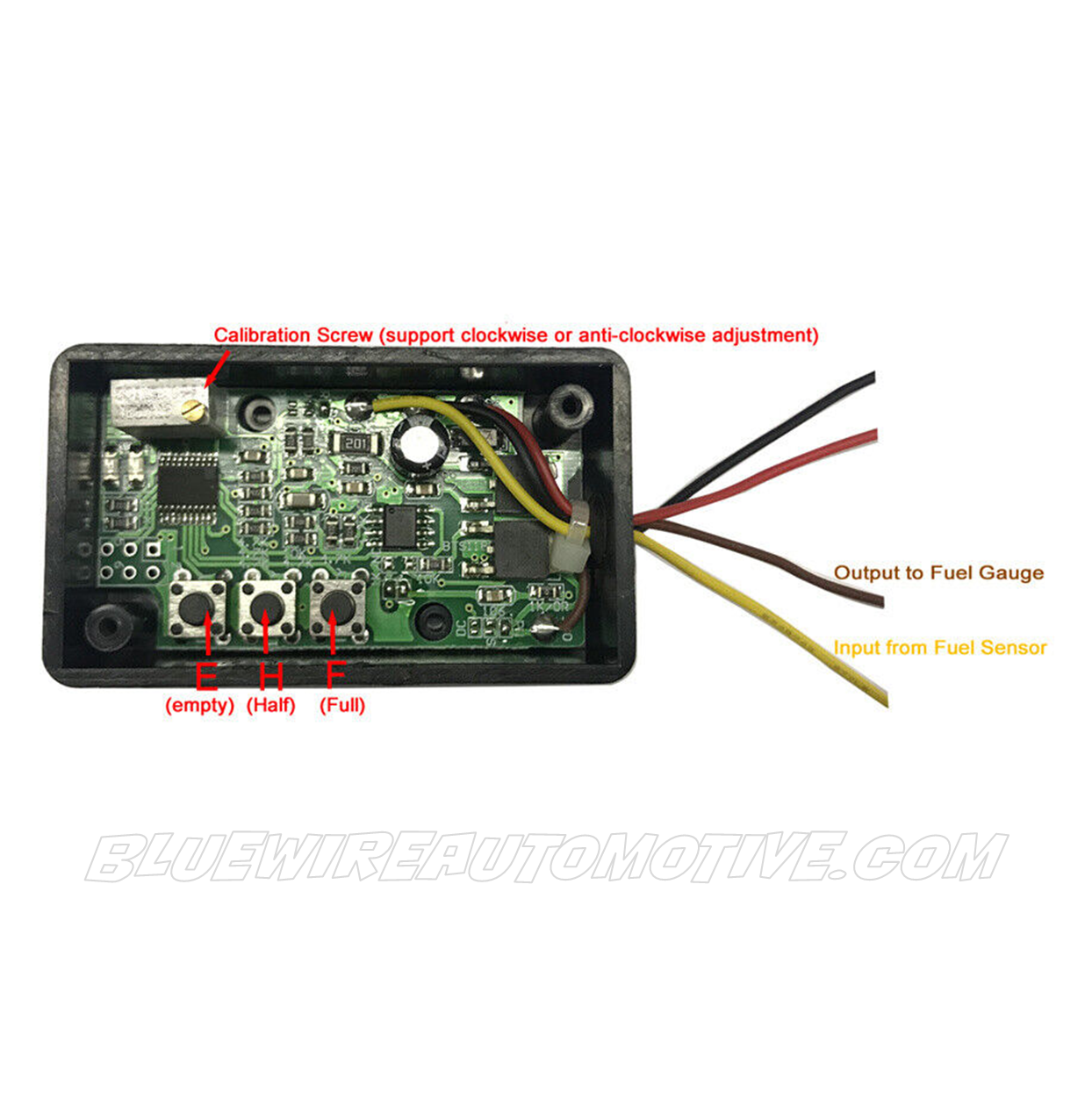
Programmable Empty, Half and Full calibration points
Programmable power-on gauge position
Microprocessor-controlled operation
Automatically calculates linear readings between Empty, Half and Full
Compact design for easy installation
Suitable for 12V DC automotive applications
Only 4 wires required for connection
Custom Calibration
Rather than being limited to one predetermined sender range, the module can be programmed specifically for your fuel sender and gauge combination.
The Full, Half and Empty positions can be individually calibrated and stored. Once programmed, the built-in microprocessor calculates the intermediate fuel levels to provide a linear progression between these calibration points.
The gauge's power-on position can also be configured to use either the sender position or a programmed starting position.
Wiring
Wire Colour
Connection
Black
Earth / Ground (-)
Red
Ignition (+)
Brown
Output to Fuel Gauge
Yellow
Input from Fuel Sender
Specifications
Part Number: BWAFSM01
Operating Voltage: 12V DC
Number of Wires: 4
Wire Length: Approx. 15cm
Supported Resistance Range: 0–5000Ω
Output: NPN pulse-width-modulated (PWM) signal
Compact module design
Installation & Programming
Mount the module in a clean, dry and cool location, then connect the four wires according to the wiring guide.
Using Store Mode, program and save the Full, Half and Empty fuel levels along with the required power-on position. The power-on mode can then be configured to determine how the gauge behaves when the vehicle is started.
Once calibration is complete, operate the unit in Run Mode and check the gauge throughout its operating range.
Important Installation Notes
For accurate operation, the fuel tank sender must share the same ground/earth as the interface module. An incorrect or poor ground may result in erratic fuel gauge readings.
When making adjustments, move the gauge through its range from Full to Empty to help avoid hysteresis errors. Some fuel gauges respond slowly, so allow sufficient time for the gauge to stabilise before making further adjustments.
The module uses an NPN pulse-width-modulated output, which may cause an audible buzzing sound in some undamped fuel gauges.
BWAFSM01 – a practical solution for matching otherwise incompatible fuel senders and fuel gauges.